The Provenance Premium: How Artisanal Scottish Gold Is Carving Out a Market That Industrial Mining Cannot Reach
There is a particular quality to gold recovered by hand from a Highland river. It arrives in irregular, water-smoothed fragments — occasionally as a fine dust clinging to the grooves of a sluice pan, sometimes as a recognisable nugget whose shape reflects centuries of geological and fluvial movement. It carries no certificate of origin from a multinational refiner, no bar number stamped into a uniform rectangle. What it carries, instead, is something that industrial production cannot replicate: an unbroken, verifiable connection to a specific place, a specific landscape, and a specific human act of recovery.
That connection is rapidly acquiring commercial value.
The Limitations of Industrial Gold as a Luxury Material
To understand the appeal of artisanal Scottish gold, it helps to understand what it is not. The global gold supply is dominated by large-scale mining operations producing refined metal that is, by design, indistinguishable from any other refined metal of equivalent purity. A 999.9 fine gold bar produced in Western Australia is chemically identical to one produced in Ghana or Kazakhstan. This fungibility is, of course, the entire point for commodity traders and financial institutions. For a jeweller crafting a commission piece for a client who wants their wedding ring to mean something beyond its material composition, it is a profound limitation.
The luxury goods sector has long understood that consumers in the upper market segments are purchasing narrative as much as product. The provenance of a cashmere fibre, the named estate on a whisky label, the specific vineyard behind a Burgundy — these details are not incidental to the value proposition; they constitute it. Scottish gold, with its ancient geological heritage, its association with specific river systems and Highland landscapes, and its recovery by identifiable craftspeople operating under transparent conditions, offers precisely the kind of narrative architecture that premium goods markets reward.
Who Is Driving the Demand?
The customer base for artisanal Scottish gold is not homogeneous, and understanding its distinct segments is important for producers and investors alike.
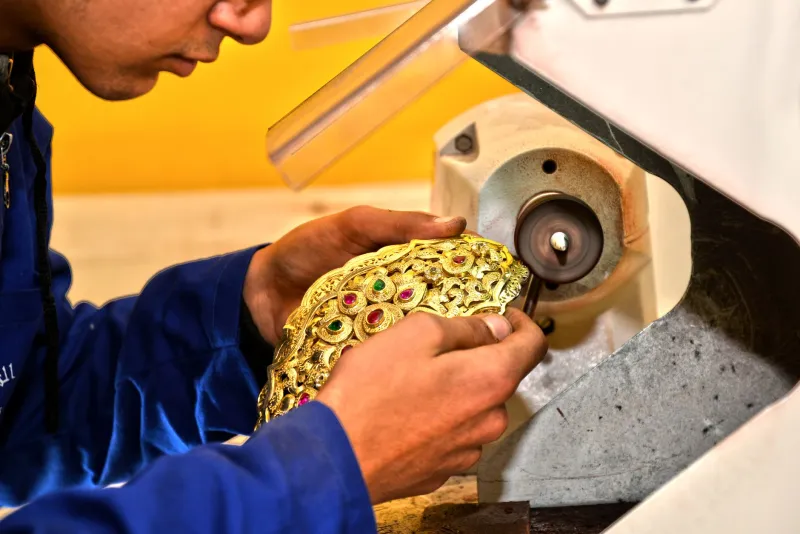
Bespoke jewellery clients represent the most established demand stream. A growing cohort of Scottish and UK-based jewellers — many of them trained in traditional goldsmithing and operating from workshop studios rather than retail premises — have built practices around commission work that explicitly incorporates provenance as a selling point. For these makers, sourcing Scottish-origin gold is not a marketing exercise but a philosophical commitment that their clients share and are willing to pay for. Commissions incorporating documented Scottish gold now command premiums of 30 to 80 per cent above equivalent pieces made with standard refined metal, depending on the complexity of the work and the depth of the provenance documentation provided.
Heritage and commemorative collectors form a second, increasingly active segment. Limited-edition coins, medallions, and presentation pieces incorporating Scottish gold have found receptive audiences among collectors who regard the metal's origin as integral to the object's significance. Several Scottish organisations — including historical societies, clan associations, and cultural bodies — have commissioned bespoke pieces as gifts or fundraising vehicles, specifically because the use of Scottish-origin gold amplifies the cultural resonance of the object.
Ethical luxury buyers constitute a third category whose importance is growing fastest. This group — typically affluent, environmentally conscious, and sceptical of opaque global supply chains — is actively seeking goods whose production they can trace and whose environmental footprint they can assess. Hand-panned or small-scale mechanically recovered Scottish gold, extracted without cyanide processing, from rivers within a closely regulated national context, presents an almost ideal profile for this buyer.
The Economics of Small-Scale Supply
The commercial reality facing artisanal Scottish gold producers is more complex than the premium pricing might suggest. The fundamental constraint is volume. Even the most productive recreational and small-commercial prospecting operations on Scotland's gold-bearing rivers — the Helmsdale in Sutherland, the Tay tributaries in Perthshire, the rivers of the Southern Uplands — yield quantities measured in grams per season rather than kilograms. The gap between what the market might absorb and what the landscape can sustainably provide is significant.
This scarcity, however, is not purely a problem. For the bespoke jewellery market, limited supply reinforces exclusivity. A maker who can credibly tell a client that their ring contains gold recovered from a specific Highland river in a specific year — and that only a handful of comparable pieces exist — is offering something that abundance would destroy. The economics of artisanal Scottish gold are, in this sense, structurally different from those of industrial mining: scarcity is a feature, not a defect.
The challenge lies in building the infrastructure to connect supply with demand reliably. At present, the pathway from a prospector's pan to a jeweller's bench is informal, inconsistent, and poorly documented. Establishing credible chain-of-custody certification — analogous to the Fairtrade Gold standard that has gained traction in the broader ethical jewellery sector — would materially enhance the commercial value of Scottish artisanal gold by providing the documentation that premium buyers require.
Heritage Crafting and the Cultural Dimension
Beyond jewellery and collectibles, Scottish gold is finding a place in a broader heritage crafting movement that draws on the nation's deep traditions of metalwork, clan symbolism, and material culture. Silversmiths and goldsmiths working within Scottish craft traditions are incorporating native gold into pieces that explicitly reference that heritage — sgian-dubh fittings, clan badge mounts, presentation quaichs — and finding that the use of Scottish-origin metal transforms a craft object into something closer to a cultural artefact.
This dimension is not commercially trivial. Scotland's cultural tourism economy is substantial, and the appetite for authentically Scottish luxury goods — as distinct from mass-produced tartan merchandise — is well established. Artisanal gold products positioned within this context benefit from an existing premium market infrastructure: craft galleries, heritage visitor centres, and the growing network of Scottish luxury goods retailers who have built international client bases on the strength of authentic provenance.
Can the Niche Sustain Itself?
The honest answer is that artisanal Scottish gold occupies a commercially viable but inherently constrained market position. It will not displace industrial production, nor should it attempt to. Its value lies precisely in its difference from industrial production — in the human scale of its recovery, the specificity of its origin, and the stories it enables makers and buyers to tell.
What the sector requires, to fulfil its potential without compromising the qualities that make it valuable, is not expansion but professionalisation: robust provenance documentation, sector-wide ethical standards, and the kind of collective brand identity that Scottish whisky and Harris Tweed have built over generations. The raw material — in every sense — is already there.